Carbolyt calculates corporate carbon and water footprints, tracks Turkish ETS, CBAM and TSRS obligations and produces audit-ready reports. Behind every result sit its formula, its factor and its official source.
Carbolyt brings a data-aware assistant, smart suggestions in every module and calculation rules tied to the official texts into one platform, backed by an expert team for your most complex processes.
Online 24/7
24/7 AI assistant
A data-driven assistant that answers instantly. It sees a summary of the screen you are on; every figure comes from that summary and every citation from a verified source list.
Is any category in this inventory below the materiality threshold?
Yes, two categories appear below the threshold. Neither has an exclusion rationale yet; shall I open those lines?ISO 14064-1 · materiality
Runs only with company consent; line data and personal data are never sent out.
Always up to date
Current regulation, article by article
New regulations are built into the calculation rules as they are published; each rule is pinned with an article reference and an automated test.
TR-ETSRegulation · OG 33353
CBAMIR 2025/2620 · 2026/1740
TSRS 2POA · OG 33323
F-gasRegulation · OG 32693
Smart suggestions in every module
Like an experienced verifier’s first look: unconfirmed lines, empty categories, uncertainty statements and base-year policy, in priority order.
Unconfirmed lines
Missing uncertainty statement
Base-year policy
Real professionals
Our expert team is with you through complex processes: from setup and data import to the monitoring plan and the verification file.
Audit-ready from day one
Calculation trail, tamper-proof audit log and verifier accounts come as standard; a positive opinion locks the inventory.
What is Carbolyt?
Onecalculationchain,frommeasurementtofiling.
In most companies the corporate GHG inventory, the ETS installation report, the CBAM declaration and the TSRS disclosures are prepared in separate files by separate teams, and the same fuel ends up with three different numbers. Carbolyt takes the data once; the inventory, installation report, border declaration and sustainability report are all produced from the same record. Every line is stored with its formula, factor and official source.
1992UN Framework Convention on Climate Change adopted
1997Kyoto Protocol
2015Paris Agreement
2021Türkiye ratifies the Paris Agreement
2025Climate Law No. 7552 enters into force
2026CBAM definitive period and Turkish ETS pilot
How it works
Fromdatatoreportinfoursteps.
Each step feeds the next; no spreadsheet is copied by hand in between.
01
Collect
Bring in data via the Excel template, e-invoice import and the supplier portal. Every row is previewed; faulty rows are shown before anything is written.
Excel
e-Fatura
Supplier portal
02
Calculate
Factors resolve by country and period. Results are frozen gas by gas, with formula and source; updating a factor never rewrites a past report.
IPCC 2006
DESNZ 2026
AR6
03
Report
ISO 14064-1 report, ETS installation report, CBAM declaration, TSRS and GRI outputs all come from the same calculation.
PDF
XML
CSV
04
Reduce
Set targets against the base year, rank measures by cost and compare fuel-switch scenarios.
SBTi
MACC
Scenarios
Modules
Oneplatform,eightcalculationareas.
Data is entered once. Inventory, installation report, border declaration and sustainability report come from the same record, so the numbers never disagree.
The Turkish ETS pilot started with five sectors; CBAM covers six goods groups. The platform calculates both from the same production data.
ETS pilotCBAM
Cement
Clinker ratio, calcination process emissions, grey and white clinker kept apart.
ETS pilotCBAM
Iron & steel
Benchmark by production route, precursors, mass balance.
ETS pilotCBAM
Aluminium
PFC emissions from anode effects, primary and secondary production split.
ETS pilotCBAM
Fertilisers
N₂O from nitric acid, precursor accounting along the ammonia and urea chain.
ETS pilotCBAM
Power generation
Allocation with installation-specific benchmark and sector correction factor.
ETS pilotCBAM
Hydrogen
Outside the 50-tonne threshold; liable at any import volume.
CBAM
Inside the platform
Everythingbehindthenumber,onscreen.
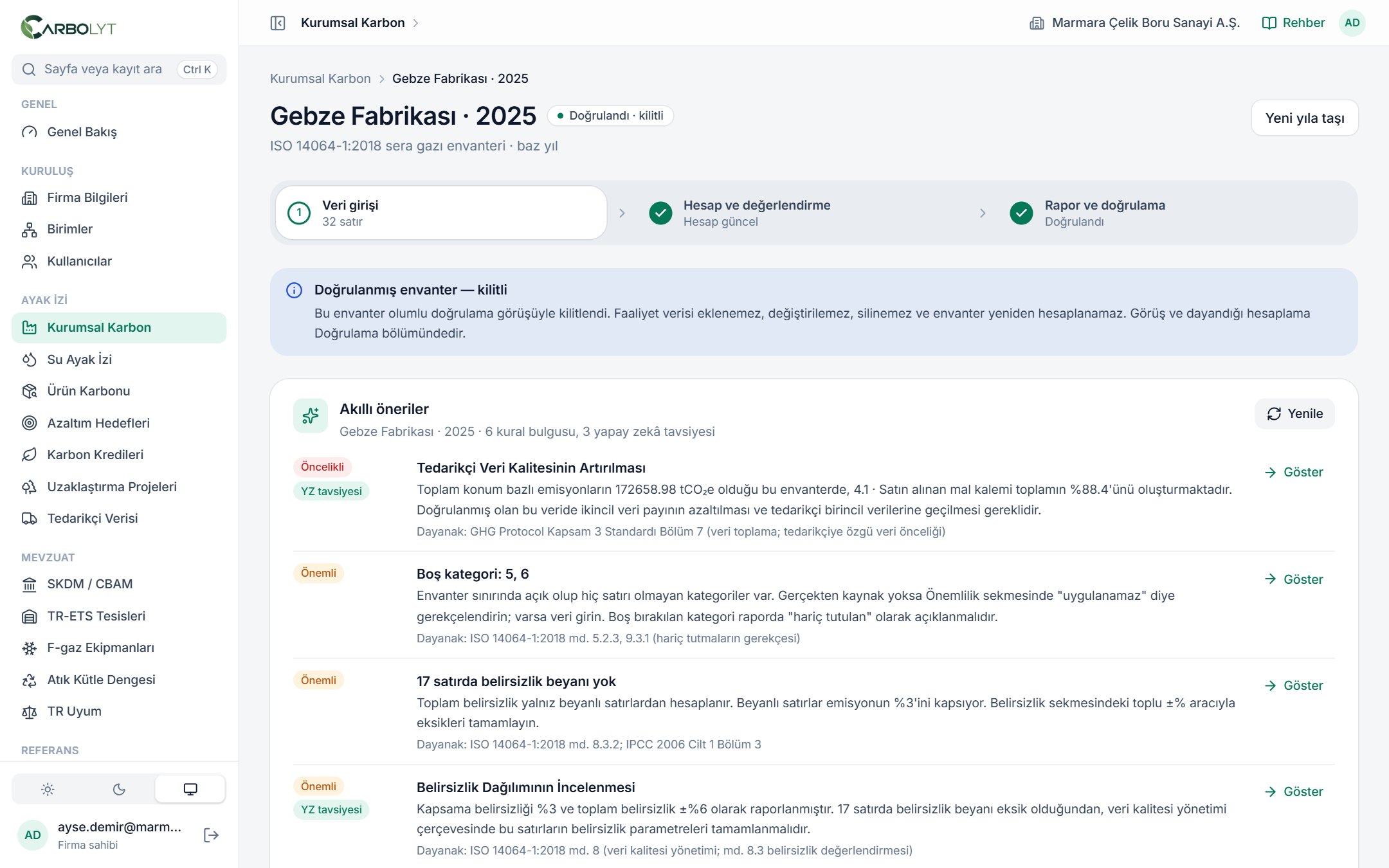
Screenshots from the platform, showing a sample steel pipe manufacturer’s inventory.
01
Inventory workspace: data entry, calculation, report and verification in one place
A three-step workflow shows where you are; the section list on the left takes you to materiality, assumptions, uncertainty, base year, report and verification for the same inventory.
Bulk import via Excel template, free-form Excel and e-invoice (UBL-TR)
Formula, factor and source table of every line in the calculation trail
A verified inventory is locked, down to the database level
02
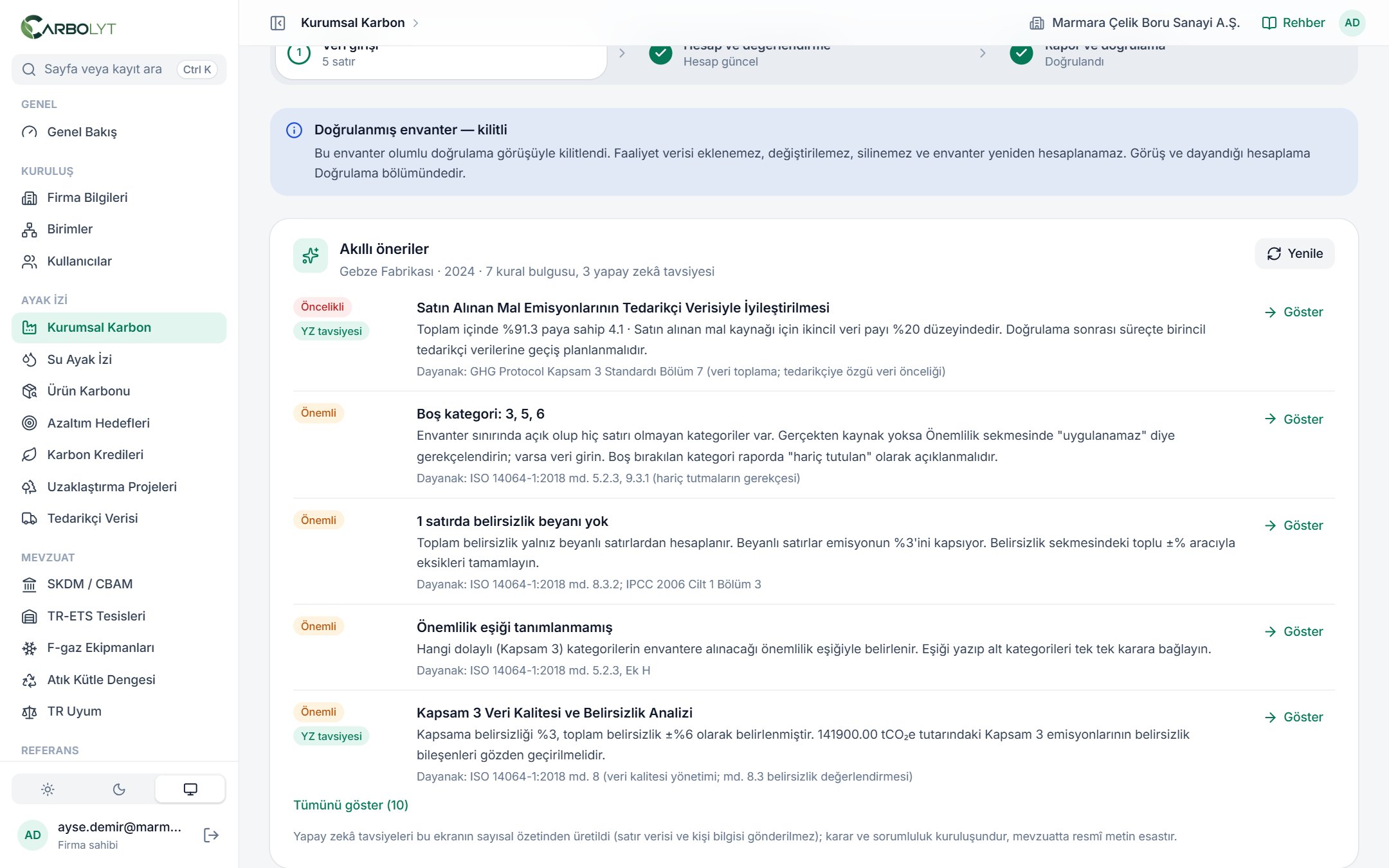
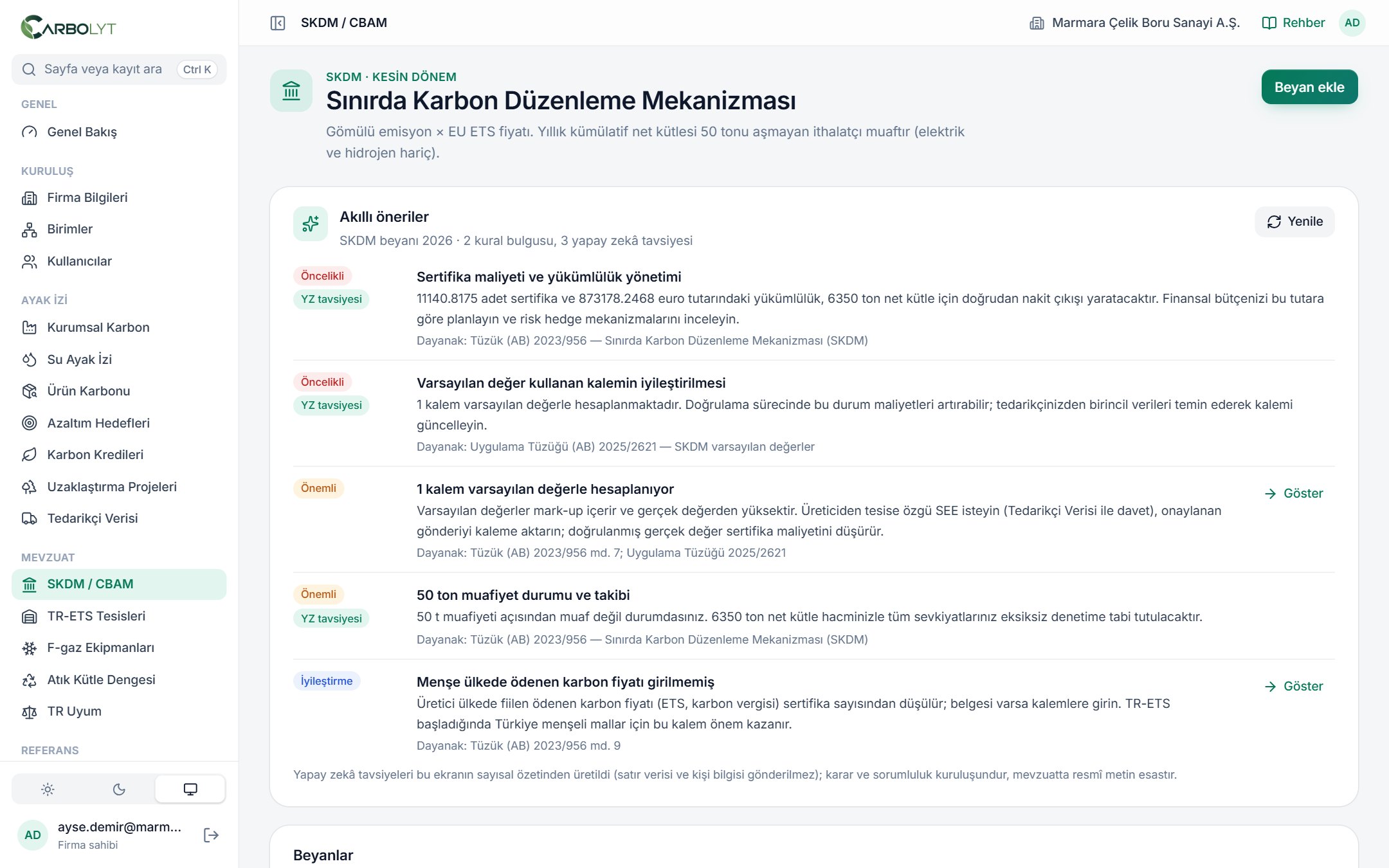
Smart suggestions: an experienced verifier’s first look, in every module
The platform lists gaps in priority order from the inventory’s own data: unconfirmed lines, empty categories, lines without an uncertainty statement, materiality threshold, base-year policy. Each suggestion states its basis.
Rule findings are produced on the server; company data stays inside
With company consent AI advice is added: only figures from the summary, only verified sources
Advice that fails the filter is removed, and the user sees that it was
03
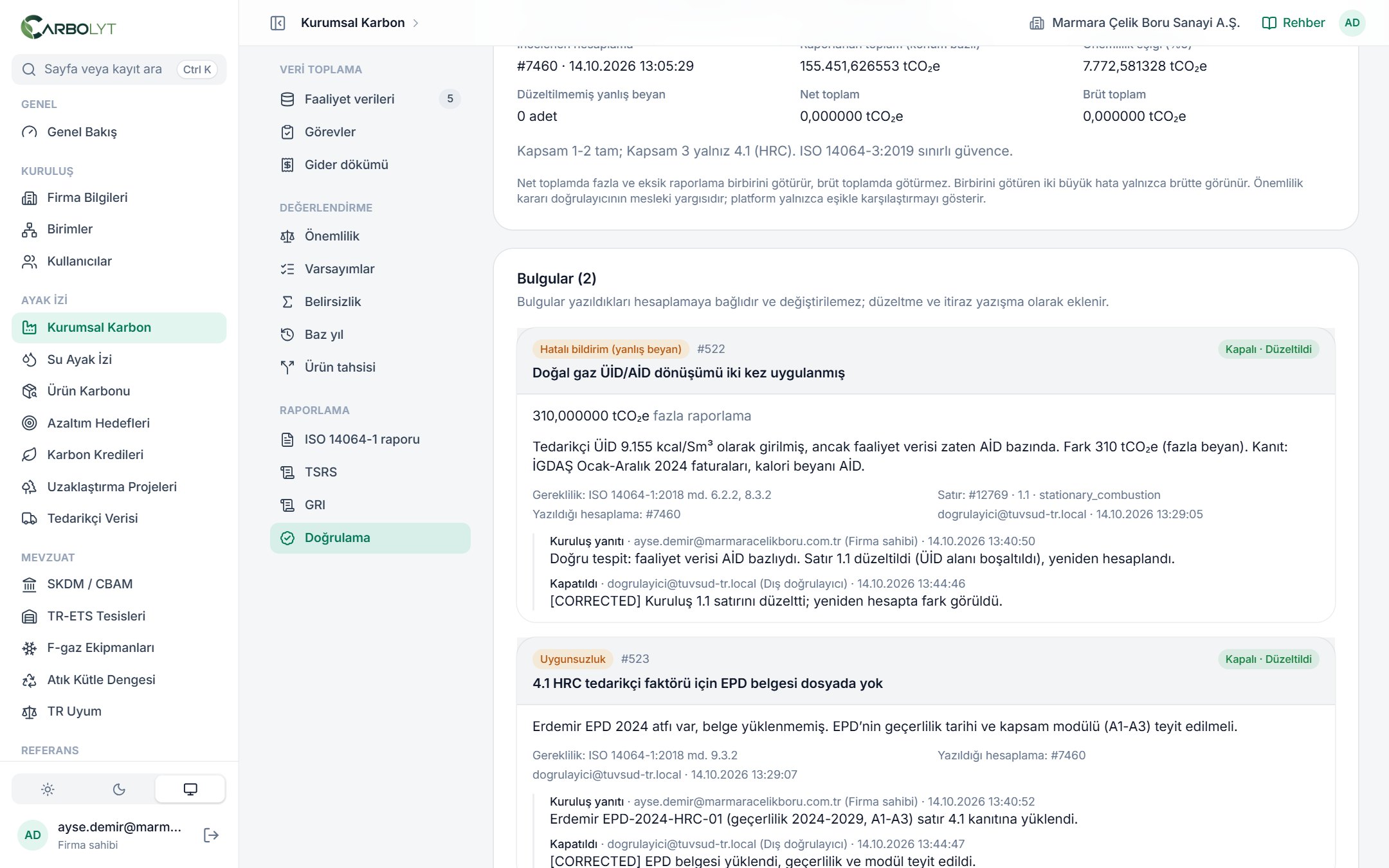
Verification: findings, correspondence, opinion and independent review
Your verifier works in the platform with their own account: reads the data, writes findings, the organisation responds. No opinion can be issued while a finding is open; a second verifier approves the opinion or returns it with reasons.
ISO 14064-3, Turkish Verification Communiqué and EU AVR frameworks
Materiality threshold, net and gross misstatement totals
The inventory is locked after a positive opinion
04
CBAM declaration: embedded emissions, certificates and projection, line by line
Enter lines by CN code, country of origin and net mass; the obligation is calculated with default values, mark-ups, free allocation adjustment and the official quarterly price, and exported as XML.
The 50-tonne exemption is tracked through the year
Projection to 2034 and quarter-end certificate holding
Actual values from the supplier portal flow into the line
Corporate Carbon · Gebze Plant · 2025
The cost of waiting
Everyunpreparedyearcostsmore.
The rates and amounts below are taken from the texts in force; they are not estimates.
SKDM
Mark-up on default values
The share added to embedded emissions when the EU default value is used instead of actual production data.
0%2026
0%2027
0%2028+
IR (EU) 2026/1740 · Annex I intro (1% for fertilisers)
SKDM
Free allocation shrinks every year
The deduction from the CBAM obligation shrinks together with EU producers’ free allocation.
Directive 2003/87/EC · Art. 10a(1a)
TR-ETS
Late verified report
Administrative fine for an installation that misses the annual emissions report deadline (2026 amounts).
from0up to0
TL
×2 inside the ETS
80% reduction in the pilot
Climate Law Art. 14
Worked example
Dragtheslider,watchtheobligationmove.
Hot-rolled flat steel (CN 7208) of Turkish origin, using the EU default value, first quarter of 2026. The platform builds and stores this chain for every declaration line.
Once the threshold is crossed, all goods of that year are liable (Regulation (EU) 2023/956 Art. 2a/2).
Regulatory calendar
Thedeadlinesahead.
The platform filters these dates by your inventory and installation category and shows yours on the dashboard.
First monitoring methodology plan
Turkish ETS pilot installations · Regulation Provisional Art. 3/1
Next up
TSRS 2 amendments mandatory
POA decision · Official Gazette 28.07.2026/33323
CBAM certificate sales begin
Regulation (EU) 2023/956 Art. 20
First verified emissions report
Turkish ETS · 2026 emissions
2023-2025 activity level reports
Power generation installations · Procedures Art. 13/10
First annual CBAM declaration
For 2026 imports · Regulation (EU) 2023/956 Art. 6
Emissions permit
Climate Law entry into force + 3 years
Surrender of allowances for system year 2027
Turkish ETS pilot · Procedures Art. 6/2
Water footprint
Waterismeasuredalongsidecarbon.
Blue water is water consumed; grey water is the volume needed to dilute a pollutant to acceptable levels, set by the most critical pollutant. The water scarcity footprint uses the site-specific AWARE factor.
Blue
withdrawal − return to the same basin
Green
evaporation of rainwater stored in soil
Grey
load ÷ (Cmax − Cnat)
Who it is for
Samedata,fourdifferentdesks.
See the whole company in one inventory.
Consolidate branches by equity share or control approach.
Track the base year and get an alert when the recalculation threshold is crossed.
Follow your TSRS scope and Scope 3 relief period.
Assign tasks and follow data owners’ entries.
Produce the installation report from the monitoring plan.
Classify source streams and see the required tier.
Record laboratory analyses and sampling frequency.
Declare biomass fraction and its basis per stream.
Prepare the annual emissions and activity level reports from one dataset.
Give your EU buyer verified data.
See the default value and mark-up cost of your goods.
Calculate actual embedded emissions from your production processes.
Compare actual data against default values in EUR.
Export the declaration as XML.
Work on your client’s data with your own account.
The company grants you time-limited, role-restricted access; every session is logged.
Open the line, factor and source behind every total.
Assign tasks, record findings and issue your opinion.
The inventory locks after a positive opinion.
Why Carbolyt
Aspreadsheetcalculates;Carbolytproves.
For a one-off calculation a spreadsheet is enough. The Turkish ETS, CBAM and TSRS ask where every number came from, which version produced it and who approved it. Here is the difference, point by point.
Spreadsheet versus Carbolyt
Topic
In a spreadsheet
Frozen calculations
Update an emission factor and the formula chain silently recalculates past years; last year’s report now shows a different number.
Each calculation stores the factor version and rule it used. New factors apply only to new runs; if you recalculate, the difference is logged as a methodology change.
Line-by-line audit trail
Tracing a total means following formulas cell by cell; a verifier’s question can take days.
Every line shows its formula, factor, official source table and article reference in one click: from total to line, from line to source.
Stops on a missing factor
An empty cell counts as zero; the total comes out short and nobody notices.
If a factor is missing the line does not return zero: it names the factor, country and period that are missing. Every assumption leaves a warning in the trail.
One dataset, every filing
Corporate inventory, ETS installation report and CBAM declaration live in separate files; the same natural gas ends up with three numbers.
ISO 14064-1 report, ETS monitoring plan (Annex 4) and annual report (Annex 6), CBAM XML, TSRS and GRI outputs all come from the same record, so the numbers agree.
Official tables, loaded and tested
CBAM default values and emission factors are copied from PDFs by hand; one wrong cell affects the whole declaration.
10,910 CBAM default values, 2,465 benchmarks and 556 DESNZ 2026 factors loaded one-to-one from official files; 1,028 automated tests check them against hand-derived values.
Verification inside the platform
Files go back and forth by email; findings sit in a separate list and nobody is sure which version was verified.
Your verifier signs in with their own account: writes findings, you respond, an opinion is issued. After a positive opinion the inventory is locked at database level.
Who changed what, and when
In a shared file, the last save wins and changes leave no trace.
Every change goes to an audit log that cannot be edited or deleted. Consultant and verifier access is limited by role and time; two-factor sign-in is standard.
Supplier data in one place
Spreadsheets from suppliers arrive in different formats and are merged by hand; which value has evidence gets lost.
Suppliers get a no-login form link; precursor data arrives with evidence and the approved value flows into the CBAM line or product footprint.
Deadlines per installation
Monitoring plan, verified report and CBAM deadlines sit in a separate calendar and depend on who remembers.
The platform filters deadlines by installation category and inventory and shows them on the dashboard, each with its legal basis.
Starting from spreadsheets is fine: the platform template and your own layout are both read, and rows are previewed and validated before import.
What is in the demo account, and what happens after 3 days?
Every module is open in the demo and the account is yours alone; nobody else sees your data. After three days the account closes automatically and can no longer be signed into. No payment details are requested, so nothing is ever charged.
Where do the emission factors come from?
Combustion factors come from the 2006 IPCC Guidelines, distance and waste factors from the DESNZ 2026 set, the Turkish grid factor from the Ministry of Energy publication and CBAM values from the EU implementing regulations. Each factor is stored with its version and source document; you can add your own supplier factor with its source.
Will my past reports change when the rules change?
No. Every completed calculation stores the factor version and calculation rule it used. New rules apply only to new calculations; if you recalculate an inventory, the difference shows up as a methodology change.
All I have is spreadsheets. Can I start?
Yes. The template you download from the platform contains the source codes and units; your own spreadsheet layout can be read too and its lines mapped. Uploads are previewed first: each row is validated, errors are shown, and only valid rows are written after you confirm.
What happens if a factor is missing?
The calculation does not return zero. The line stops and tells you which factor is missing for which country and period. Wherever an assumption is used, a warning is written to the calculation trail.
Does AI see my data?
Only if you allow it. Rule-based findings are produced on the server and no data leaves it. If you switch on data sharing in Company Settings, a numerical summary of the current module is sent to the language model to draft advice; line data, personal names and document contents are not sent. Every figure in the advice must come from the summary and every citation from a verified source list; advice that fails these checks is removed.